What is the game of the 7 families?
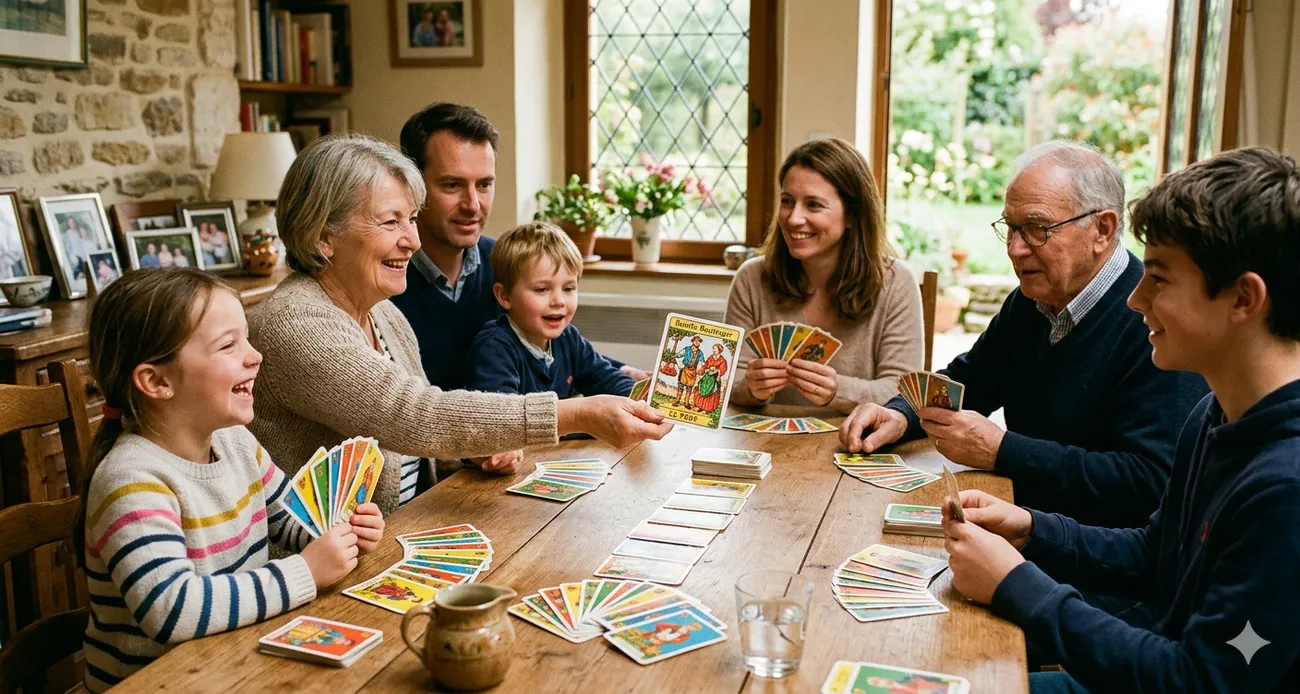
What Is the Game of the 7 Families? The Classic Card Game Explained
If you have ever browsed a French toy shop or stumbled upon a beautifully illustrated deck of cards in a Parisian market, chances are you have encountered the Jeu des 7 Familles, the Game of the 7 Families. Simple enough for young children yet charming enough for adults, this classic card game has been a staple of French family life for well over a century. But what exactly is it, where did it come from, and how do you play it? Let's find out.
What Is the Game of the 7 Families?
The Game of the 7 Families is a French card game designed for 2 to 6 players, typically aged 4 and up. The deck consists of 42 cards divided into 7 families, with 6 members in each family. Each family usually represents a type of household such as the Baker family, the Carpenter family, or the Fisherman family, and each member has a role: father, mother, son, daughter, grandfather, and grandmother.
The objective is straightforward: collect complete families. The player who assembles the most complete families by the end of the game wins.
The Origins: A French Classic with a Rich History
The Jeu des 7 Familles dates back to 19th-century France, with its roots closely tied to traditional Parisian printing and game-making culture. It is widely considered one of the earliest purpose-designed children's card games in Europe.
Early editions featured beautifully hand-illustrated cards depicting families in period clothing, offering a fascinating window into 19th and early 20th-century French social life. The artwork varied by publisher, but most decks shared a warm, storybook quality that made them feel like collectibles as much as games.
Over the decades, the game evolved. Modern editions feature themed families ranging from animals and professions to fantasy characters and cartoon figures, making it accessible and appealing to new generations. Yet the core structure, 7 families and 6 members each, has never changed.
How to Play: The Rules Explained
The rules are delightfully simple, making this an ideal first card game for young children.
Setup: Shuffle the 42 cards and deal them evenly among players. Any remaining cards form a central draw pile.
Gameplay: On your turn, ask any opponent for a specific card by naming the family and the member. For example, "Do you have the Baker's daughter?" If the opponent has the card, they must hand it over and you get another turn. If they do not have it, you draw a card from the pile and your turn ends.
Winning: When you collect all 6 members of a family, place the completed set face down in front of you. The game ends when all 7 families are complete. The player with the most complete families wins.
The game rewards memory and observation. Keeping track of which cards opponents have asked for gives sharp players a significant edge.
7 Families of the World: International Variants
One of the most popular modern versions is 7 Families of the World, where each family represents a different culture or country such as the Japanese family, the Brazilian family, or the Indian family. This variant has become especially popular in schools across Europe as a fun, low-pressure way to introduce children to global cultures and geography.
Other popular themed variants include:
- Animals of the World - each family is an animal species
- Fairy Tale Families - characters from classic European folk tales
- Professions - families based on different jobs and trades
- Superheroes and Fantasy - modern editions for pop culture fans
Happy Families: The British Cousin
If the 7 Families game sounds familiar to British readers, that is because England has its own version called Happy Families, first published around 1851 by John Jaques of London. The structure is almost identical: collect complete families of four members. British editions traditionally feature comic, caricatured characters like Mr. Bun the Baker and Mrs. Chip the Carpenter's Wife.
While Happy Families uses 4 members per family rather than 6, the gameplay mechanics are essentially the same. Both games share the same fundamental charm: they are easy, social, and require just enough strategy to keep older players genuinely engaged.
Why the Game of the 7 Families Still Matters
In an age of tablets and digital games, the enduring appeal of the Jeu des 7 Familles lies in its simplicity and warmth. It requires no batteries, no screen, and no setup beyond a shuffle. It teaches children how to ask questions politely, how to remember information, and how to handle winning and losing gracefully.
For families learning French, it is also a wonderful educational tool. Many editions are used in French language classrooms worldwide, helping children learn vocabulary for family members, professions, and everyday objects in a natural, playful context.
Where to Buy the Game of the 7 Families
The game is widely available online and in toy shops. Look for it under:
- Jeu des 7 Familles on Amazon France or Amazon India (imported editions)
- Happy Families for the British variant
- French educational toy retailers for classroom-grade editions
- Board game specialty stores for artisan or vintage illustrated decks
Prices typically range from Rs 300 to Rs 800 for standard editions, with premium illustrated decks available for more.
Conclusion
The Game of the 7 Families is one of those rare games that transcends generations, languages, and cultures. Whether you are playing the classic French original, a 7 Families of the World variant, or the British Happy Families edition, the experience is the same: simple, joyful, and endlessly replayable. If you have not introduced it to your family yet, there has never been a better time to start.